Peter
When you fly into one of the New York City airports there is often a moment when the plane descends out of the clouds and the shapes on the ground come into focus as rows and rows of apartment buildings, townhouses, brownstones, tenements. I would always wonder at this sight of so many homes: who lives in these spaces? What are their lives like? In one of those older buildings in Hell’s Kitchen, for decades, lived Peter.
He was nearing the end of his life when I started dating his upstairs neighbor, Grant. Peter was tallish, sixties, always slim with precisely cut hair and a coiffed mustache. Clothes were neat, and carefully selected even if he was just running a quick errand. Think: pressed jeans with a long-sleeved paisley collared shirt and a buttoned-up denim vest to complete the look. Peter’s apartment was a tiny studio where every possible inch of space was filled: plants covered the windowsill, framed prints and needlework were nailed to the walls, statues rested stoically on the rugs. Oddly, it did not feel crowded in the apartment even around the holidays when a live tree and dozens of Santa figurines came out of storage. Each piece (and plant) was so meticulously chosen and neatly placed that it all worked like a curated puzzle. One got the feeling that much of Peter’s time was involved with the purchase and placement of art for his apartment. This must have been how he transitioned from work in a gallery to spending most of his time at home on disability. He used his keen eye for recognizing how colors and patterns could live together in his space.
In the early days, sometimes Peter would poke his head outside of his door when I was in the stairwell and admonish me for accidentally pushing his buzzer. (Had I?) Or he would accost me on the landing to ask if we would be around later to help move his television. At random intervals, he would turn up at Grant’s door with various requests. While some were fairly pedestrian (can I borrow your wi-fi, can you turn down the stereo), others were a tad out of the mundane (can you store this half-eaten tube of meat and these dinner rolls in your freezer?). He would offer peculiar teas or years-old half melted candies in return for our help. Once Peter cracked his door as far as it would open (the back of the front door was used for hanging clothes) and invited me inside past the oversized antique wardrobe (how did he ever get that in here?) into the bathroom where he had stored a giant weaving loom in the tub. Turns out he was offering to teach me to weave. I declined.
Over the years, he warmed a bit especially after I brought him a plant once on a warm early-spring afternoon. We also brought home cooked food periodically once I saw the kinds of things he ate (the tube of discount meat!) and found out he only had a dorm-sized refrigerator. One time when we brought over some kale soup, despite his closely guarded privacy, he invited us inside and offered the daybed for us to sit on. The cover of the daybed, we were informed, was specially imported needlework from South America. After a few moments, he abruptly announced in his breathy measured speech: “Well, I better eat that soup now.” Indicating that we were now meant to leave. There was a Christmas when he specifically asked us down to see his collection of ornaments and décor. It seemed endearing that he wanted someone to share in the enjoyment of viewing his objects. That day he even let Grant take a selfie of the three of us together. But, just as frequently, I’d see him on the street, and he would walk by as if he didn’t recognize me.
He invited me—only me, weirdly, since he had known Grant much longer—for tea once. Over black and white cookies and an herbal infusion, his paranoia abated long enough to share some of his backstory. His family was all distant, geographically and emotionally. He had left his hometown in Jersey as a teenager to experience queer life in the City in the late 1960s. The array of medicines on the counter of his bathroom illustrated that it had been a journey with many trials. He longed for companionship but had been assailed by heartbreak. I cautioned him about meeting people online and quietly worried about his safety. His nervous twitches belied a deep vulnerability, and his cursory manner seemed to say: “I won’t share much or come too close.”
One day, I want to say out of the blue, but everything was out of the blue with Peter, he told Grant that he was putting aside a substantial amount of money for us to pack and donate his art to a gallery when he died. Surprised, Grant agreed thinking that day would be a long way off. Could it be that we were his closest friends, we wondered. Then Grant moved in with me across the Hudson, and we did not see him as much. We invited him for holiday dinners knowing that he’d never come. When we heard a brick was thrown through his window, we were concerned. Was it malicious homophobia or just drunken street people? This would surely irritate his neuralgia. He did not have much extra money in his monthly budget. Would the landlord help with repairs? It became hard to get Peter on the phone.
The distance between us and Peter grew. Distance being relative since we never felt we knew him well. Then COVID enveloped the City. We checked in with him and learned he couldn’t leave the apartment at all because he was immuno-compromised. We hoped he made it to his doctor appointments. What would he do with his frozen meat now?
We didn’t learn of Peter’s death until weeks after it happened when a neighbor called. We couldn’t go over there because of the quarantine, and we couldn’t call his family because we had no contact information. No one did. Peter had never written out a will to our knowledge even though we reminded him several times to type out his wishes. We had no right to be involved in his estate without a will, but what would happen to his cherished objects? Where would his neatly ironed clothes end up? His beloved plants? The valuable artwork he said he wanted us to have? The woven bedspread? The only comforting thought was that Peter was not around to see his meticulously curated domicile dismantled.
For years I have wondered: what was the lesson—besides writing down one’s last wishes—to be learned from knowing Peter? Maybe the hardest lesson of all to accept is that the City is full of Peters. They are with us living out their lives every day and then, sometimes suddenly, they are gone. And there is nothing we can do. The City keeps moving, the people keep walking the sidewalks of Hell’s Kitchen. The airplane lands and everyone disperses to carry on with their lives.
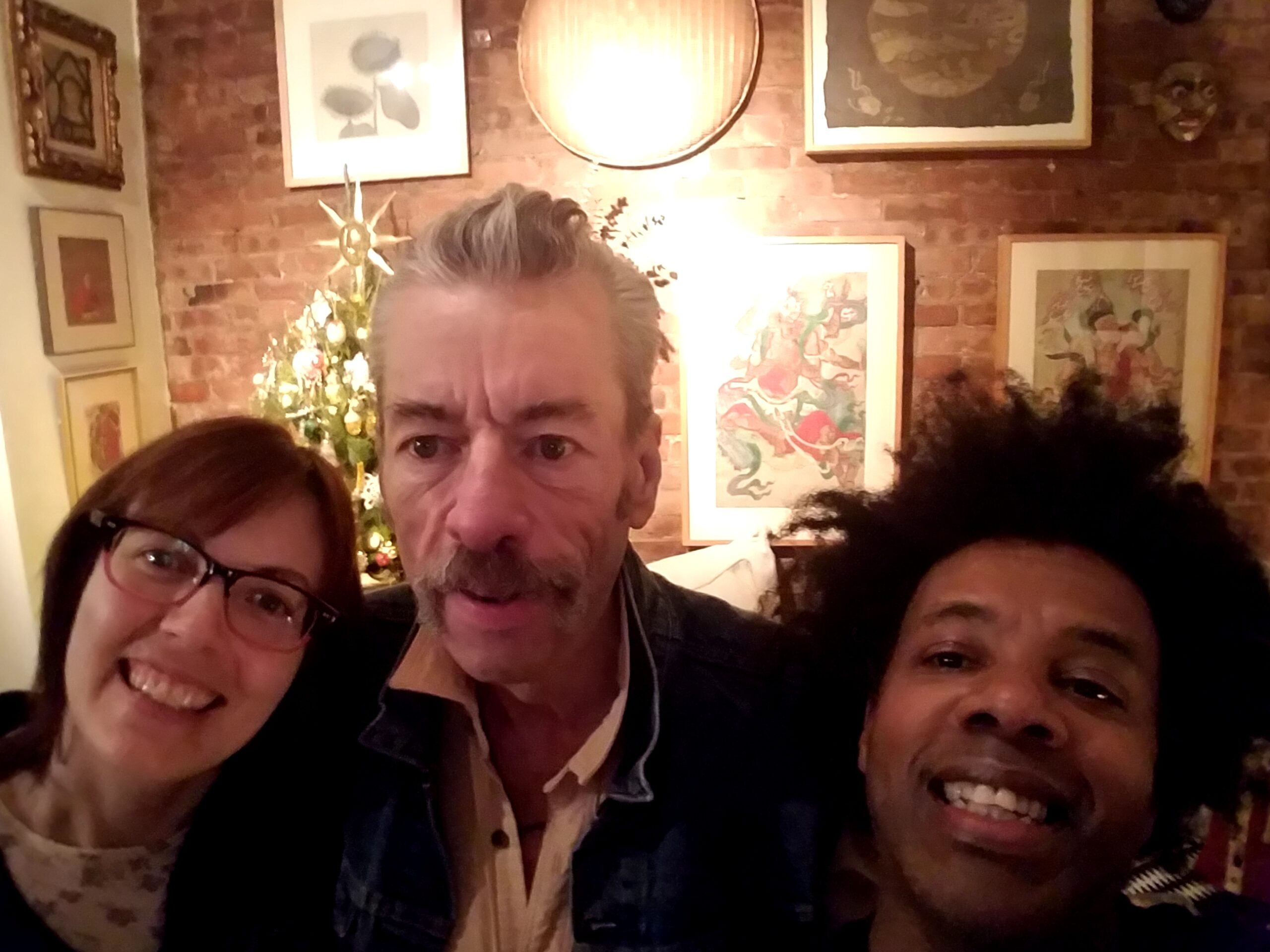
The Christmas selfie of Peter with Lindsey and Grant.

Lindsey Swindall
Lindsey R. Swindall, Ph.D. is a writer, educator and co-founder of Winfield Artists, LLC. She has written several academic books in the field of African American Studies. Her writing has been also published in literary and scholarly journals including Theatre Journal, James Baldwin Review, Lunch Ticket, Litro Magazine, New Jersey Studies and The MacGuffin.